Mobile NFC Passport Reading: A Smarter Way to Verify Identity Anytime, Anywhere
2026-04-24Mobile NFC Passport Reading: A Smarter Way to Verify Identity Anytime, Anywhere
In an increasingly digital and mobile-driven world, identity verification is no longer limited to fixed locations or dedicated hardware devices. Businesses today require solutions that are not only secure and accurate but also flexible enough to operate directly on smartphones. Mobile NFC passport reading is emerging as a powerful technology that enables fast, reliable, and secure identity verification using standard Android and iOS devices, transforming how industries handle customer onboarding, travel verification, and compliance processes.
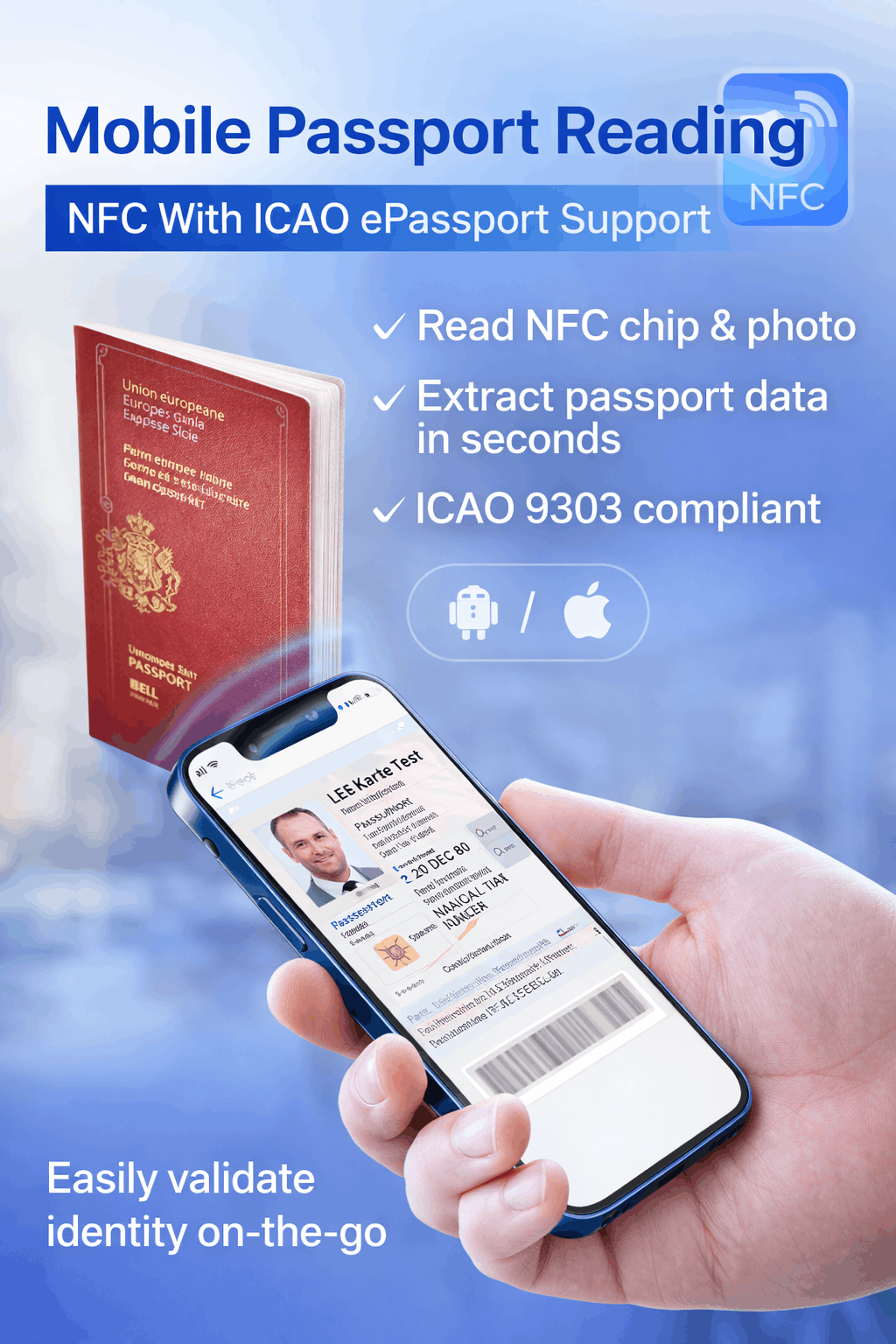
Mobile NFC passport reading leverages the built-in Near Field Communication (NFC) functionality of smartphones to access the embedded chip inside electronic passports. With a simple tap, the mobile device can securely read and extract passport chip data, including personal information such as name, nationality, date of birth, and passport number, as well as the holder’s high-resolution facial image. This eliminates the need for external passport readers and allows organizations to perform identity verification directly within their mobile applications, greatly improving efficiency and user experience.
One of the key advantages of this technology is its compliance with international standards. The solution supports passports that follow ICAO Doc 9303 specifications, ensuring compatibility with electronic passports issued worldwide. This global compatibility makes mobile NFC passport reading highly suitable for applications such as telecom SIM registration for foreign users, international hotel check-in, financial KYC onboarding, and border or travel-related services. By supporting standardized data structures and chip access protocols, the system ensures consistent performance across different passport types and issuing countries.
In addition to NFC chip reading, the solution integrates optical character recognition (OCR) technology to scan the passport’s visual page. By combining OCR data from the MRZ (Machine Readable Zone) and visual inspection zone with data extracted from the NFC chip, the system enables cross-verification to ensure data consistency. This dual-channel approach significantly enhances security by detecting discrepancies between printed and electronic data, helping prevent fraud and identity tampering. Passive Authentication mechanisms further verify that the chip data has not been altered, ensuring the authenticity of the passport information.
Another important benefit is that passport reading itself does not require an internet connection. Both OCR recognition and NFC chip data extraction can be performed entirely offline on Android and iOS devices, making the solution ideal for environments where connectivity is limited or unreliable. At the same time, if additional verification processes are required—such as validating certificates or updating public key data—these can be performed through network connectivity when available. This flexible online-offline capability ensures that the system can adapt to different operational scenarios without compromising performance.
From a development perspective, mobile NFC passport reading solutions are designed for seamless integration into existing applications. SDKs for Android and iOS provide developers with the tools needed to quickly implement passport recognition functionality, including APIs for data capture, processing, and output. The SDK architecture is optimized for efficiency, allowing developers to focus on application logic while the underlying engine handles complex tasks such as chip communication, data parsing, and image processing. This significantly reduces development time and lowers integration costs, making it easier for companies to deploy identity verification features at scale.
The technology is already being widely adopted across multiple industries. In telecom, it enables fast and compliant SIM card registration for international customers. In hospitality, it supports mobile-based check-in processes, reducing wait times and improving customer satisfaction. In banking and fintech, it streamlines digital onboarding by allowing users to verify their identity remotely using their smartphones. In travel and transportation, it enhances passenger processing and supports self-service experiences. Across all these use cases, mobile NFC passport reading delivers a combination of speed, convenience, and security that traditional methods cannot match.
Ultimately, mobile NFC passport reading represents a significant step forward in digital identity verification. By utilizing the capabilities of modern smartphones, organizations can eliminate the need for dedicated hardware, reduce operational costs, and provide a more seamless user experience. With support for Android and iOS platforms, global passport compatibility, and advanced verification capabilities, this technology is well positioned to become a standard component of next-generation identity solutions.