Wintone Passport Reader: Comprehensive Passport Authentication Through Image, OCR, Chip Data and Cross-Verification
2026-07-28Wintone Passport Reader: Comprehensive Passport Authentication Through Image, OCR, Chip Data and Cross-Verification
In modern border control, hotel registration, airport check-in, banking KYC, immigration services and self-service terminals, passport reading is no longer limited to simple data capture. Customers need a solution that can not only read passport information quickly, but also help determine whether a passport is genuine, complete and trustworthy. The Wintone Passport Reader is designed for this purpose. It integrates passport data reading and document authentication into one system, providing a more reliable identity verification process for professional applications.
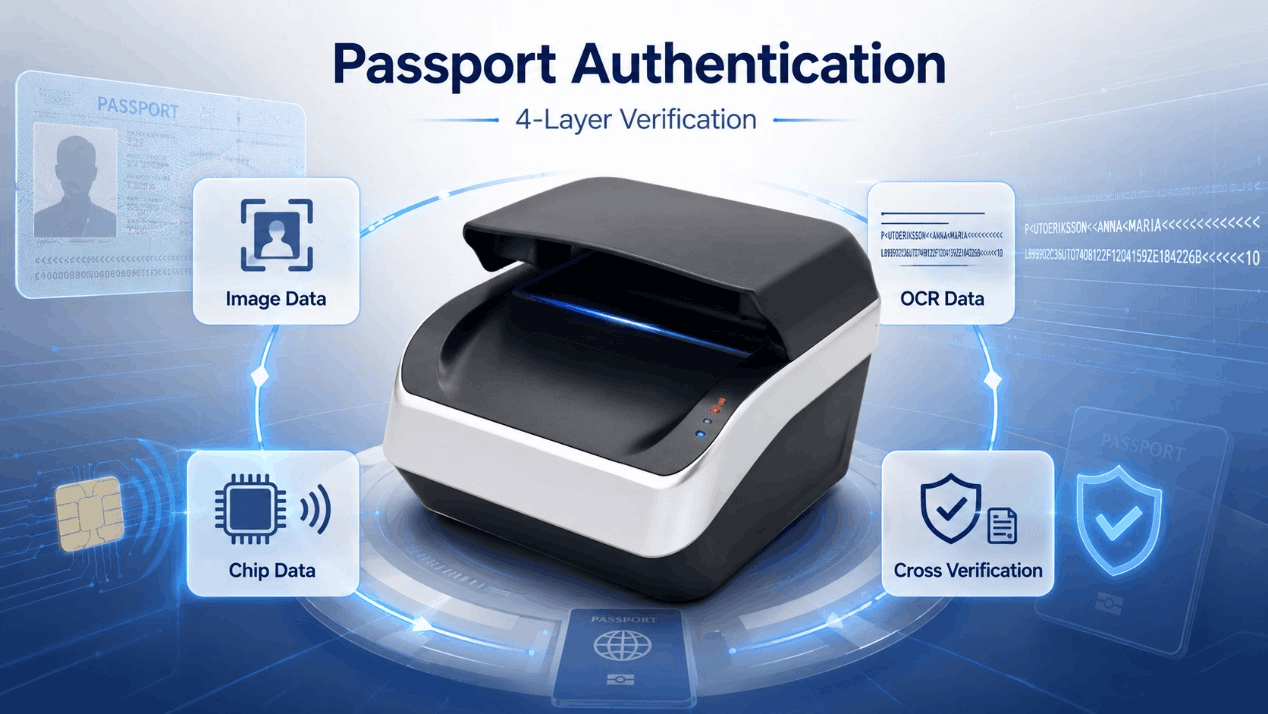
The Wintone Passport Reader performs passport authentication based on four major groups of anti-counterfeiting features: image data verification, OCR data verification, chip data verification and cross-verification. These four layers work together to build a complete inspection workflow. Instead of relying on only one type of evidence, the system collects and compares multiple sources of passport information, making verification more accurate and more convincing.
The first layer is image data verification. According to the ICAO 9303 recommended process, passport images can be captured under different light sources, such as visible light, infrared and ultraviolet light. These images provide important evidence for document inspection. The verification software obtains multi-light images from the passport reader and analyzes document content through OCR, image classification and reference database comparison. The system can check whether the passport layout, image area, security patterns and visible features are consistent with the expected template.
This image-based inspection is supported by a verification database and a reference database. The verification database stores inspection rules and feature models for passports from different countries and different versions. The reference database stores sample images of genuine documents under visible, infrared and ultraviolet light, which can be used for manual comparison and system-assisted analysis. In this way, the reader is not only capturing an image, but also transforming passport images into useful security evidence.
The second layer is OCR data verification. OCR data refers to the text information recognized from the MRZ area and VIZ area of the passport. The Wintone Passport Reader can use this OCR data to check the legality and validity of the document information according to ICAO 9303 rules. For example, the system can inspect the position and character width of the MRZ zone to confirm whether the machine-readable area is correctly printed and aligned.
More importantly, the system can verify MRZ check digits. A passport MRZ usually contains multiple check digits, such as the document number check digit, date of birth check digit, expiry date check digit, optional data check digit and final composite check digit. These check digits are generated according to defined calculation rules. If any data has been modified or incorrectly printed, the check digit verification may fail. This provides a strong method to detect abnormal or inconsistent passport data.
OCR verification also includes country and region code validation. The system can check whether the country code recognized from the passport is included in the legal country code list defined by international standards. In addition, date-related data can be inspected for format validity and expiration status. For example, the system can check whether the passport has expired or whether the date format is reasonable. These OCR-based inspections help detect common data errors, abnormal documents and possible tampering.
The third layer is chip data verification. For electronic passports, the chip provides a highly important security source. The Wintone Passport Reader supports access to passport chip data through BAC or PACE, allowing the system to securely read the chip content. Once the chip data is obtained, the system can perform electronic passport authentication, including Passive Authentication and integrated circuit authentication.
Passive Authentication checks the trust chain of the chip data. The system can verify the relationship from CSCA to CDS, from CDS to SOD, and from SOD to DG1 through DG16. This process helps confirm whether the data stored in the chip has been modified. If the chip data does not match the digital signature structure, the system can identify potential risks. In addition, the system can support Active Authentication and Chip Authentication, which are used to verify the authenticity of the passport chip itself. This helps prevent cloned or forged chips from being accepted as genuine documents.
The fourth and most powerful layer is cross-verification. In a secure passport, key information usually appears in multiple data sources. For example, the document number may appear in the MRZ, VIZ and chip DG1. The holder’s name may appear in the visual inspection zone, the MRZ and the chip. The facial image may appear on the printed photo page and also in chip DG2. This natural redundancy makes cross-verification a very effective anti-counterfeiting method.
The Wintone Passport Reader compares these repeated data points across image data, OCR data and chip data. Typical cross-checks include MRZ versus DG1, document number comparison among VIZ, MRZ and chip DG1, name comparison among VIZ, MRZ, DG1 and DG11, date of birth comparison, expiry date comparison, gender comparison, and portrait comparison between the printed photo and the chip image in DG2. If all data sources are consistent, the confidence level of the verification result is significantly improved. If inconsistency is found, the system can flag the document for further review.
This multi-layer verification approach brings clear value to customers. First, it improves security. By combining optical image inspection, OCR rule checking, electronic chip authentication and cross-data comparison, the system can detect more types of document fraud. Second, it improves efficiency. Many checks can be completed automatically, reducing manual work and shortening the verification process. Third, it improves reliability. The result is not based on a single field or single image, but on multiple independent data sources.
For industries such as border control, airports, hotels, banking, telecom, customs, immigration and self-service kiosks, passport authentication is directly related to operational security and service efficiency. A simple passport scanner may only read information, but the Wintone Passport Reader goes further. It helps users verify whether the passport data is reasonable, whether the chip is authentic, whether the document information is consistent, and whether potential fraud risks exist.
In conclusion, the Wintone Passport Reader provides a comprehensive passport authentication solution built on four groups of security features: image data, OCR data, chip data and cross-verification. This structure follows international passport verification logic and supports real-world identity verification needs. By turning passport reading into intelligent document authentication, Wintone helps customers build safer, faster and more trustworthy identity verification workflows.
By Wintone