Will Rapidly Evolving AI Large Models Replace Traditional OCR?
2026-10-15Over the past two years, AI large models have advanced far faster than many people expected. From text generation and knowledge Q&A to image understanding and multimodal interaction, large models continue to expand the boundaries of what machines can see, understand and accomplish. This naturally raises a question: if a large model can already read an image and understand the content of an identity document, does traditional OCR still have long-term value?
If the only question is whether a system can read text from an image, large models have certainly made recognition more general-purpose. But businesses do not operate in demonstrations; they operate through repeatable workflows that must work every day. Passport, ID card and driver’s license data needs to be captured quickly, separated into predefined fields, and passed directly into PMS, KYC, visitor management, membership, access control or self-service systems. At that point, the question changes from “Can the model understand it?” to “Can the system complete the process reliably?”
For this reason, large models and professional OCR are not simply substitutes for one another. Large models excel at broad understanding, reasoning and open-ended content, while professional OCR focuses on deterministic output, structured data, low latency and stable integration with business systems. In identity-document applications, where efficiency, privacy and consistency matter, professional OCR still has a very clear role.
Large Models and Professional OCR Solve Different Problems
The strength of a large model is generalization. The same model can work with natural language, images, tables and complex context, making it especially useful for unstructured document analysis, semantic Q&A and content summarization. Identity document recognition usually requires something different: whether the same document type is scanned ten times or ten thousand times, the system should consistently return predefined fields such as name, document number, date of birth, expiry date, nationality and gender, with as little uncertainty as possible.
In high-frequency workflows such as front-desk registration, hotel check-in, banking onboarding, visitor registration and self-service, the result must be not only correct but also fast, stable and directly usable by existing software. If every recognition request requires image upload, cloud inference, a returned response and then additional business-system processing, network conditions, interface latency and third-party service availability all become new variables.
Professional OCR is closer to a long-term business infrastructure capability. It is continuously optimized for document layouts, field positions, image quality and recognition rules, and it produces structured results that software can consume immediately. For enterprises, this predictability is often more important than how many different tasks a single model can perform.
On the Hardware Side: Put Recognition Directly on the Device
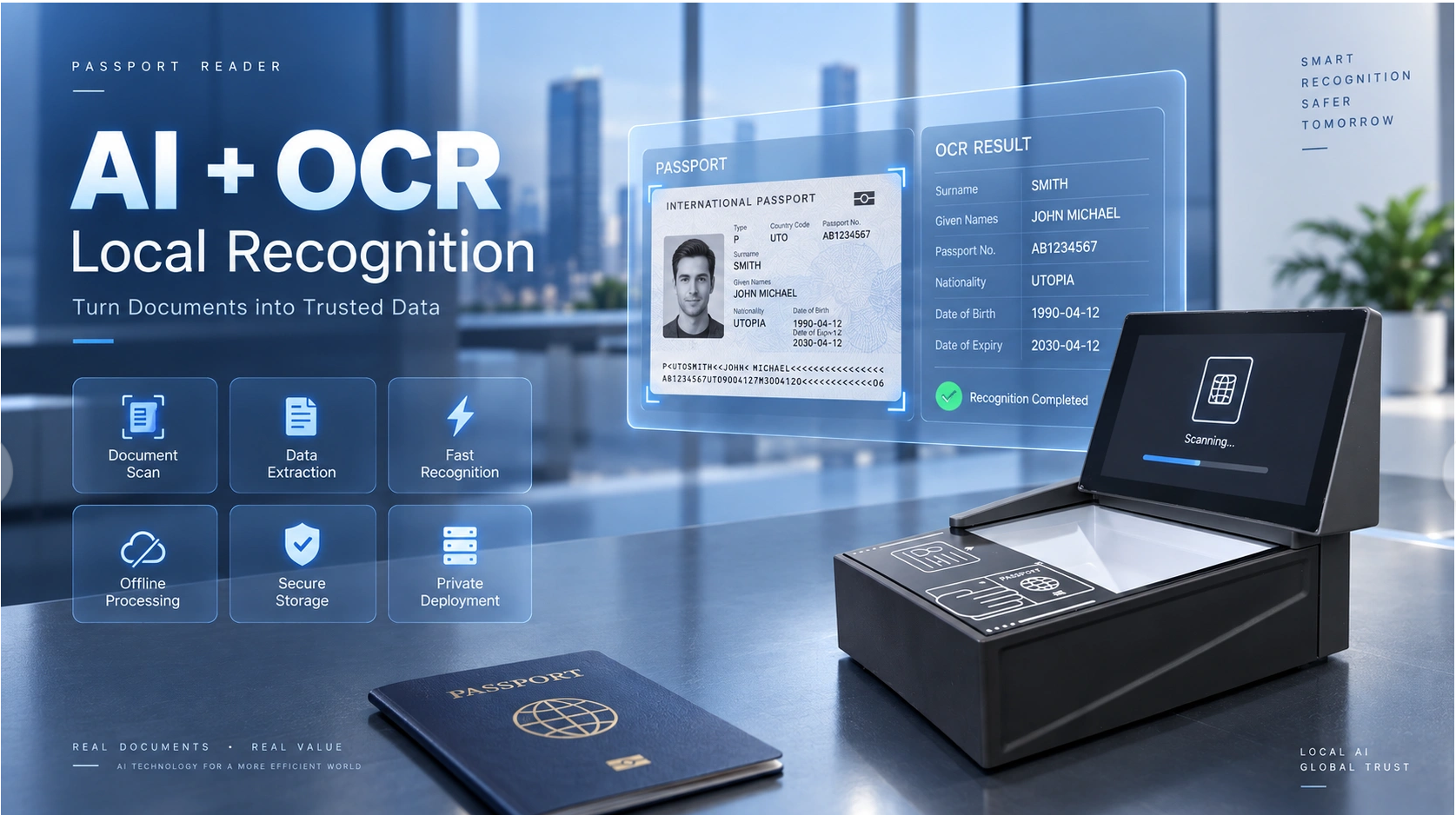
Take the Wintone ER series as an example. The devices provide Wintone’s own SDK, allowing document capture and OCR recognition capabilities to be deployed directly on the device side. In typical applications, document images do not need to be uploaded to an external cloud for recognition, and recognition does not depend on external network quality. Projects also do not need to prepare a complicated PC operating-system environment solely for OCR, which reduces host-computer configuration and ongoing maintenance.
The value of on-device recognition becomes especially clear in high-frequency, on-site workflows. After a user places a document on the device, image capture, recognition and field output can be completed quickly. The device behaves more like a complete business component than a combination of “camera plus cloud API.” At a front desk, kiosk, access point or registration counter, stable response time and simple operation have a direct impact on the user experience.
Professional document-reading hardware also has advantages beyond the OCR algorithm itself. Stable image capture, suitable illumination, a controlled document placement area, automatic triggering and imaging optimized for identity documents all influence the final recognition result. By integrating the capture hardware and OCR software, the input becomes more controllable—an important advantage that general-purpose vision models cannot always reproduce in real deployment conditions.
On the Software Side: Private Deployment Without a Heavy Large-Model Stack
Enterprise expectations for AI are becoming increasingly practical. Many customers do not want sensitive passport or ID card information to be sent to a public cloud service. They want data processing to remain inside the corporate network, on a local server or on an endpoint device. For these requirements, OCR can be deployed privately and connected to existing business systems through standard interfaces.
Compared with solutions that may require dedicated Linux environments, GPU resources and a large-model inference stack, professional OCR can be much lighter to deploy. A company does not need to build a new AI infrastructure simply to add identity-document recognition. Instead, the recognition capability can be introduced into the existing IT architecture, reducing deployment complexity, maintenance cost and future upgrade pressure.
This means OCR is not merely standalone software. It can become a standard capability within PMS, KYC, visitor management, membership management, access control and self-service platforms. For system integrators and software developers, it is also easier to add document recognition as a module to an existing solution rather than redesigning the entire system.
A New Product Form: Bring Document Checking On-Site Without a PC
As application scenarios become more diverse, document recognition is moving beyond the traditional model of “connect a reader to a computer.” Wintone’s new standalone document verification terminal extends this idea further. The device integrates a display and document capture area and can be used directly as an on-site terminal without connecting to a PC or host computer, and without complicated external integration.
This allows identity-document recognition to enter locations where a complete IT system may have been unnecessary or impractical in the past—for example, bars, clubs, retail stores, event venues and other places that have age restrictions or basic identity-confirmation requirements. Staff do not have to start a PC, log into a system and then connect a scanner; basic checks can be completed directly on the terminal.
Basic age checking: read the date of birth from the document and assist with determining whether the person meets a preset age threshold.
Person checking: confirm basic identity information for members, visitors, staff or other designated people, with the option to combine the result with locally stored lists for further business rules.
Document checking: quickly read key document fields and expiry information, reducing errors caused by visual inspection and manual data entry.
Local data storage: recognition data can be stored locally according to project requirements, reducing unnecessary external transmission and giving customers greater control over information handling.
This type of terminal is not intended to replace bank-grade KYC or complex border-control systems. Instead, it addresses a growing middle ground: many locations simply need to confirm basic identity information quickly and reliably, but do not want to deploy servers, PCs and complex software for that purpose. Embedding OCR directly into a terminal shortens the distance between a business requirement and actual use.
From Traditional Counters to More On-Site Scenarios, OCR Is Expanding Its Reach
In the past, passport readers and identity-document OCR were mainly associated with airports, hotels, banks and government counters. As devices become more independent, software becomes lighter and local processing becomes stronger, many smaller scenarios are becoming practical. Event check-in can capture document information quickly; business parks and coworking spaces can simplify visitor registration; car rental and equipment rental companies can reduce manual entry; and retail or age-restricted venues can standardize their document-checking process.
These scenarios have something in common: their transaction volume may not justify building a large IT platform, but they still have a real need to capture and confirm identity information. A traditional “scanner + PC + server” architecture may be too heavy, while a solution that depends entirely on a public-cloud large model may raise concerns about network availability, cost and data security. Standalone terminals and privately deployed OCR sit between these two extremes and give businesses a more flexible option.
In the Large-Model Era, OCR Is About More Than Reading Text
So when we ask whether large models will replace traditional OCR, the more useful question is not which model has more capabilities in isolation, but which approach completes a real business process more efficiently. In the future, large models are well suited to open-ended tasks such as complex document understanding, semantic analysis and decision support. Professional OCR can continue to handle high-frequency, standardized and structured data capture. Endpoint devices can bring recognition and basic verification directly to the point of service, while private deployment provides a more controllable path for sensitive data.
Seen from this perspective, “traditional OCR” is not standing still. It is moving from a software function on a computer toward on-device processing, localization, private deployment and deeper industry integration. A competitive OCR product must consider not only algorithms, but also hardware, deployment, interfaces, data security and the user experience at the actual site.
For enterprise users, the decisive questions are unlikely to be about model size. They are more practical: Is recognition fast enough? Are the results stable? Is deployment simple? Can the data remain inside an environment the customer controls? When these issues are solved, OCR remains a fundamental and pragmatic AI capability whose application boundaries continue to expand.
AI large models are rapidly improving the ability of machines to understand the world. Professional OCR is doing something equally important: helping machines connect reliably to real business processes. The two do not have to compete in a zero-sum way. The more promising future may be the combination of large-model understanding, professional OCR determinism and the immediate response of localized terminals—bringing AI into many more everyday scenarios.
By Wintone