Empowering Financial Apps with the Wintone Bank Card Recognition SDK
2025-09-26Empowering Financial Apps with the Wintone Bank Card Recognition SDK
In the digital economy, the moments that matter most are often the smallest ones: the instant a new user binds a card, the split second a payment form is completed, the handoff between intent and approval. These micro-moments determine whether customers finish onboarding or abandon the flow. Bank card recognition sits at the center of this experience, yet it is frequently slowed by manual data entry, typing errors, and fragile web forms. The Wintone Bank Card Recognition SDK is built to remove this friction, giving developers a reliable, secure way to capture card data quickly and accurately inside their own apps and platforms.
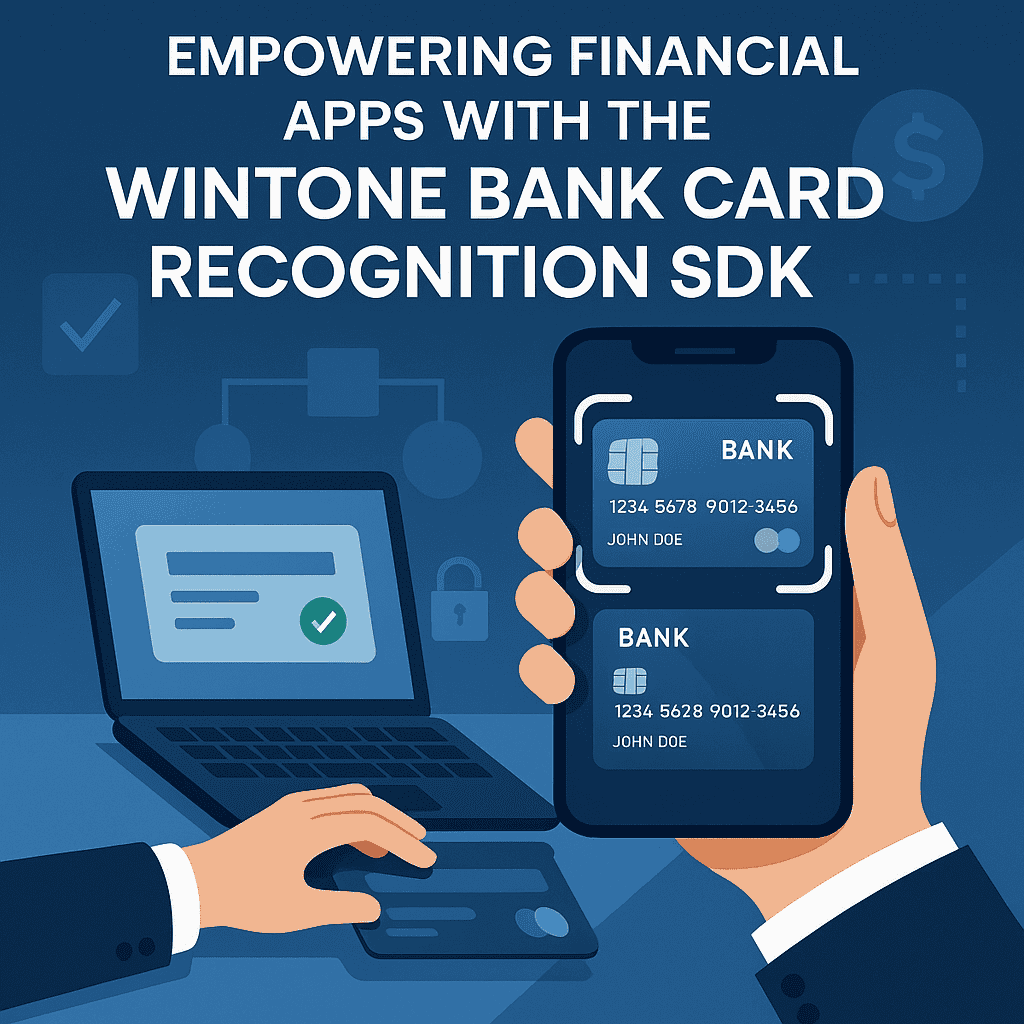
At its core, the SDK leverages Wintone’s independently developed OCR engine, optimized specifically for bank card typography and layouts. Instead of relying on users to transcribe long numbers and expiry dates, the camera captures the card and the SDK extracts the card number, cardholder name, and validity period with high precision. This accuracy holds even when conditions are less than ideal—cards with embossed or flat characters, varied fonts, and minor glare are all handled gracefully. The result is a recognition pipeline that feels instantaneous to the user and dependable to the product team.
Speed is only half the story. Financial interactions demand trust, so the SDK is designed to keep sensitive information under the developer’s control. Recognition can be performed entirely on device, which means images and extracted data need not leave the user’s phone or the institution’s secure perimeter. This local processing model reduces exposure, simplifies data governance, and helps teams align with stringent security expectations. For deployments where connectivity is intermittent—such as rural banking kiosks, offline merchant onboarding, or field sales terminals—the SDK’s offline capability ensures the experience remains fast and consistent.
Integration is straightforward for modern stacks. The SDK supports iOS and Android for mobile apps and extends to Windows and Linux for kiosks, POS, and desktop tools. A clean API surface lets developers drop recognition into existing flows—account opening, card binding, checkout, or agent tools—without rethinking their architecture. Because the output is structured and normalized, the data feeds directly into payment gateways, risk engines, and CRMs with minimal post-processing. In practice, this means teams can pilot quickly, measure conversion gains, and iterate without months of rework.
Global readiness is another defining strength. Real payment products come in countless templates, fonts, and regional conventions. The Wintone SDK is trained to accommodate these variations, allowing the same application to scale from one market to many. As organizations expand into new geographies or add new issuing partners, they can maintain a single recognition layer rather than juggling country-specific components. This reduces operational complexity while keeping product behavior consistent across regions.
For consumer experiences, the difference is immediately visible. New users can add a card with a single scan instead of pecking at a numeric keypad. Fewer typos mean fewer declines and support tickets, and the smoother journey lifts completion rates at the exact steps where businesses typically lose customers. In e-commerce checkouts, the reduction in friction translates directly into higher conversion. In mobile banking, the first-time setup feels modern and fast, which sets the tone for long-term engagement. And in self-service kiosks or teller tools, recognition shortens handling time per customer, increasing throughput without adding staff.
Security and risk teams also benefit. Accurate capture minimizes the propagation of bad data through downstream systems, and the SDK’s robust parsing reduces the edge cases that often lead to manual review. Because extraction happens locally, organizations have clearer control over logs and retention, making it easier to implement least-privilege designs and data minimization policies. When combined with device attestation, app hardening, and standard anti-tamper practices, the recognition step becomes a secure building block rather than a risk hotspot.
From an engineering perspective, the SDK’s value shows up in time saved. Teams no longer need to prototype their own computer-vision models for cards, curate training datasets, or manage a custom inference pipeline across devices. Wintone’s update cadence and compatibility focus mean developers can keep pace with OS upgrades and new hardware without pausing product roadmaps. The predictable API surface allows QA to concentrate on the business flow rather than low-level image handling.
Ultimately, the Wintone Bank Card Recognition SDK is not merely a convenience feature; it is a strategic accelerator. It compresses the distance between a customer’s intent to pay and a completed, verified transaction, while giving businesses the control and assurance they need for regulated environments. As cashless payments continue to grow and customer expectations rise, organizations that deliver fast, error-free card capture will win the crucial first impression—and the repeat business that follows.
If your next release aims to streamline onboarding, lift checkout conversion, or modernize self-service, embedding Wintone’s card recognition is one of the highest-leverage improvements you can make. It aligns user experience with security, scales across platforms and markets, and frees your team to focus on what differentiates your product—not on re-solving OCR and edge cases. In a world where every second counts, that’s the kind of advantage that compounds.