Making Trust Visible: How Identity Verification Builds Confidence in a Digital Society
2026-10-12Trust is used to be invisible. In a digitized era, identity verification turning trust into something visible, verifiable, and actionable.
Why Trust Matters?
Trust becomes visible when people move.
At an airport, a hotel desk, a bank onboarding page, or a mobile SIM registration point, people are making a claim: whether they can enter, stay, or use a service.
Trust has never been new to our society. Long before the digital era, communities relied on trust to trade, cultivate land, share resources, and build social relationships. In smaller communities, trust was often created through familiarity: people knew each other’s histories and reputations.
However, the scale of human mobility has changed dramatically. Today, people, services, and transactions go beyond geographical, institutional, and social boundaries. We increasingly interact with organizations and individuals who may know almost nothing about us.
Here a new challenge emerges: when familiarity disappears, how is trust maintained?
The answer is not that technology replaces trust. Instead, technology creates new ways to make trust visible and verifiable across distances, and to define the boundary of mobility and immobility.
From Physical to Digital Trust
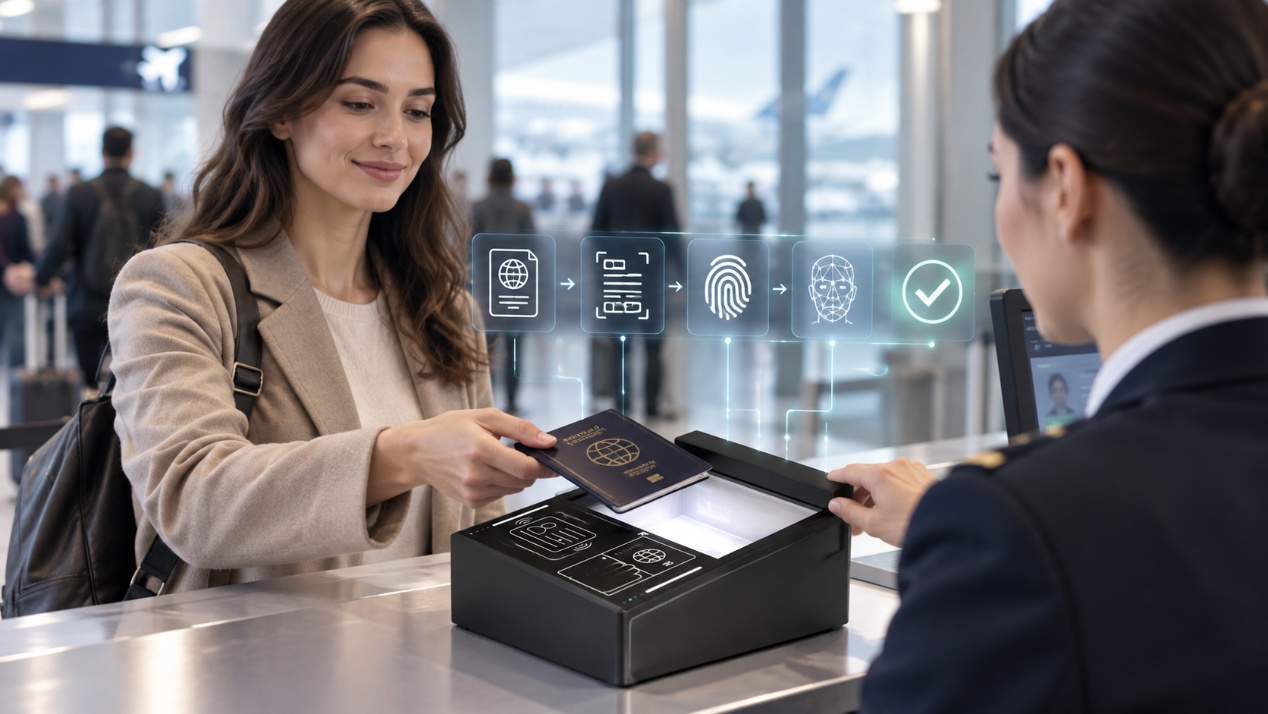
While verifying people’s identity, the process appears simple: looks at a passport, compares the photo with the traveler, checks security features, and makes a decision based on existed procedures.
Nevertheless, it could be unfolded into multiple layers of judgment: Is the identity document genuine? Has it been issued by a legitimate authority, and has it been manipulated?
Traditionally, these decisions relied heavily on human expertise. Accuracy can be affected by fatigue, workload, and differences in individual interpretation.
When the demands of mobility increase, the process is digitized. Devices can complete many of these verification tasks within one or two seconds. Does faster mean less secure?
The answer depends on how the automation is achieved.
Modern identity verification systems divide this process into multiple layers of analysis. OCR extracts structured information from MRZs, visual inspection zones, and barcodes. RFID or NFC technologies enable the reading and validation of electronic passport chips. Document authentication technologies cross-check security features and data consistency, while face comparison and liveness detection help establish the connection between the document and its holder.
These capabilities must also operate within larger ecosystems, including airports, hotels, telecommunications services, government agencies, and enterprises. Through SDKs, APIs, and flexible deployment models, identity verification technology is far more than merely a device, but an integrated trust infrastructure.
When Trust Still Requires a Tangible Foundation
Digital transformation is changing the way this trust is presented, where identity information can be through digital systems. For example, the transition of the UK Biometric Residence Permit (BRP) from a physical card to a digital status.
If identity is digitized, why do physical documents still matter?
The answer is, digital transformation still roots in the tangible and reliable chain of trust. It does not remove the relationship among the authoritative issuers, the secure credential, and the individuals claiming their identity.
Electronic passports, for example, combine physical security features with embedded digital information stored in a secure chip. The physical document provides a tangible anchor, while technologies such as RFID/NFC enable automated verification of the digital identity embedded within it. they depend on reliable issuance, secure data exchange, and compatibility with existing border-control infrastructure.
Paradoxically, identity documents may become less visible in everyday interactions precisely because the infrastructure behind them has become more important.
The Future of Trust in the AI era
Generative AI makes trust more challenging.
For decades, verification technology has become better at seeing: reading finer document features, comparing faces and identifying inconsistencies. Generative AI can now also manipulate increasingly convincing identity images.
Therefore, the problem becomes whether the system can establish where what it sees came from.
NIST’s 2025 Digital Identity Guidelines explicitly address forged media and digital injection attacks in remote identity proofing. Importantly, the guidance notes that biometric comparison by itself does not prevent such attacks. Secure identity verification increasingly has to protect the entire chain between evidence, capture device, algorithm and decision.
This suggests that the future of trust will be more layered. Document authenticity, cryptographic chip validation, biometrics, liveness detection, secure capture channels and system-level risk signals will increasingly need to reinforce one another.
At the same time, stronger verification should not automatically mean knowing more about a person. Emerging digital identity systems point toward another possibility: proving only what a transaction actually requires. The European Digital Identity Wallet, for example, is being designed around selective disclosure, allowing users to share necessary attributes without automatically exposing the rest of their identity data.
For technology provides, this changes the question from “How fast can we read this document” to “How can we establish the right level of assurance, with the least unnecessary friction and exposure, across a real operational environment”.
That is why decades of OCR knowledge, biometric technology and integration experience matter, making reader part of a much larger infrastructure.
In this way, identity verification becomes a way of making trust usable: visible enough to verify, digital enough to move, and robust enough to maintain reliable assurance in an environment where mere visual information alone can no longer be considered a sufficient basis for trust.