Wintone Passport Reader in Self-Service Visitor Registration: Enhancing Efficiency, Security, and User Experience
2026-02-12Wintone Passport Reader in Self-Service Visitor Registration: Enhancing Efficiency, Security, and User Experience
As organizations continue to modernize their facilities and embrace digital transformation, self-service visitor registration has become increasingly common across industries. From corporate offices and government buildings to hospitals, industrial parks, and educational institutions, self-service kiosks are replacing traditional manual reception processes. In this evolving environment, the Wintone Passport Reader plays a crucial role in enabling fast, accurate, and secure identity capture.
The Need for Smarter Visitor Registration
Traditional visitor registration often relies on manual entry, where visitors present their passport or ID card and reception staff type information into a system. This process is time-consuming, prone to errors, and inefficient during peak hours. It also creates queues, increases staff workload, and may result in incomplete or inconsistent records.
Self-service visitor registration terminals solve these issues by allowing visitors to register independently. However, for such systems to work effectively, they must be able to capture identity data automatically and accurately. This is where the Wintone Passport Reader becomes essential—providing automated document recognition that improves both operational efficiency and security compliance.
How the Wintone Passport Reader Works in Self-Service Kiosks
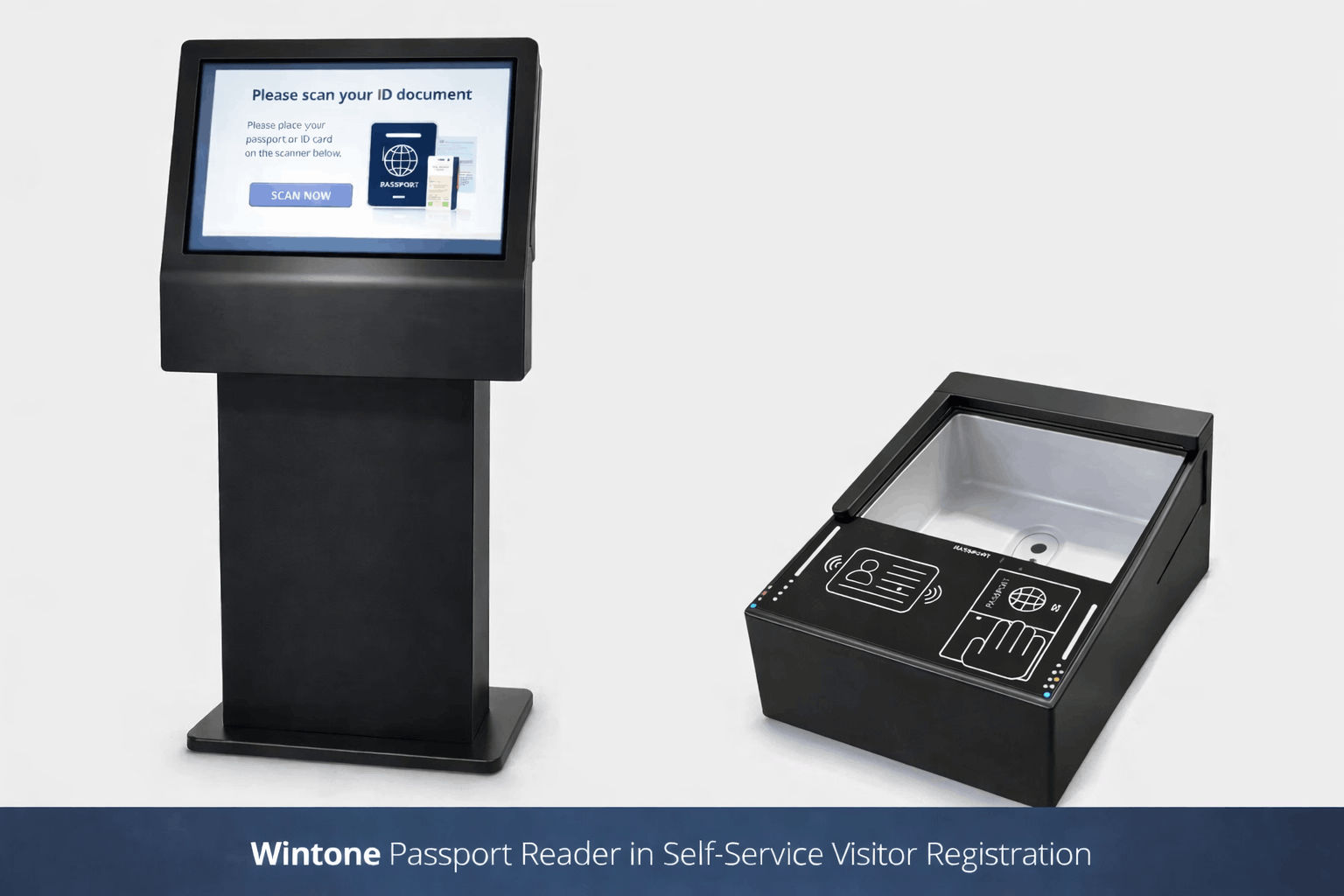
When integrated into a self-service visitor registration terminal, the Wintone Passport Reader allows users to simply place their passport or ID card on the device. Within seconds, the system captures and extracts key information such as name, nationality, document number, date of birth, and expiration date.
For ICAO-compliant travel documents, the reader automatically decodes the MRZ (Machine Readable Zone), ensuring standardized and reliable data capture. For e-passports, the reader can also support RFID chip reading, providing access to encrypted identity data stored in the document. This enhances the accuracy and authenticity of the information collected.
The extracted data is then automatically transferred to the visitor management system, eliminating manual typing and reducing errors.
Key Benefits in Visitor Registration Scenarios
1. Faster Check-In Process
Self-service registration powered by a passport reader significantly reduces waiting time. Visitors can complete registration in seconds, improving the overall experience and enabling organizations to handle higher visitor volumes efficiently.
2. Improved Data Accuracy
Manual data entry often leads to spelling mistakes or incorrect document numbers. Automated OCR and MRZ reading ensure that information is captured precisely and consistently, improving record quality and traceability.
3. Enhanced Security and Compliance
Accurate visitor identification is critical for building security and regulatory compliance. With automated document capture and optional RFID verification, organizations can strengthen identity checks and maintain reliable visitor logs for audits.
4. Reduced Operational Costs
By shifting from receptionist-based registration to automated self-service kiosks, organizations can reduce labor requirements and administrative workload while maintaining high service standards.
5. Better Visitor Experience
Modern visitors expect digital, efficient, and seamless processes. Self-service kiosks equipped with passport readers provide a professional and user-friendly experience, reducing friction during entry procedures.
Typical Application Scenarios
The Wintone Passport Reader can support a wide range of visitor registration environments:
· Corporate offices and business parks: Manage visitor entry and access permissions automatically.
· Government buildings: Secure and compliant identity verification for public service visitors.
· Hospitals and healthcare facilities: Register patients and visitors quickly while maintaining security.
· Industrial zones and factories: Ensure controlled access and accurate visitor tracking.
· Universities and campuses: Manage guest access and maintain digital visitor records.
· Events and exhibition venues: Handle large volumes of visitors efficiently.
Easy Integration with Visitor Management Systems
System integrators and solution providers can easily connect the Wintone Passport Reader with existing visitor management platforms. The device supports SDK and API integration, enabling seamless communication with registration software, access control systems, and databases.
Structured data output allows automatic mapping of fields into digital forms, reducing integration complexity and ensuring consistent performance across different deployment scenarios.
Supporting Digital Transformation and Smart Buildings
As organizations move toward smart buildings and automated facilities, identity recognition becomes a core component of digital infrastructure. Passport readers enhance the capability of self-service kiosks by transforming them into intelligent identity verification terminals.
They enable contactless processes, improve data accuracy, and support secure digital workflows—all essential for modern visitor management.
Conclusion
Self-service visitor registration is reshaping how organizations manage access and identity verification. The Wintone Passport Reader provides a reliable and efficient solution for capturing passport and ID data automatically, reducing manual processes, and enhancing security.
By integrating advanced OCR, MRZ decoding, and optional RFID technology into visitor kiosks, organizations can deliver faster check-ins, improve operational efficiency, and create a more professional visitor experience.
For system integrators, facility managers, and security solution providers, adopting a passport reader is not just an upgrade—it is a strategic step toward smarter, safer, and more efficient visitor management.